Round vs rectangular wedding tables: sizes, capacity and layout
The tables you choose decide how many fit in the room, how easy it is to talk across them and how the reception feels. Here is how many guests fit at each common size, how much space to plan for, and when each shape works best.
How many guests fit at each table
These are typical figures for banquet chairs and a plated dinner. Each guest needs about 24 inches (60 cm) of table edge; with larger charger plates or chairs with arms, use the lower number.
| Table | Size | Comfortable | Maximum |
|---|---|---|---|
| Round | 48 in (122 cm) | 6 | 8 |
| Round | 60 in (152 cm) | 8 | 10 |
| Round | 66 in (168 cm) | 10 | 11 |
| Round | 72 in (183 cm) | 10 | 12 |
| Rectangular | 6 ft × 30 in (183 × 76 cm) | 6 | 8 (with ends) |
| Rectangular | 8 ft × 30 in (244 × 76 cm) | 8 | 10 (with ends) |
| Long / banquet row | several tables end to end | about 2 guests per 4 ft (122 cm) of length, both sides | |
Your venue has the final word. Table sizes and the number that fit vary between venues, so confirm with your coordinator before you finalize the chart.
Round tables
Rounds are the classic wedding reception table, and for good reason.
Pros
- Everyone can see and talk to everyone else at the table.
- Easy to seat a group of 8 or 10 together, which matches how most guest lists are grouped.
- Servers can move around them easily, and they make a balanced, open-looking room.
Cons
- They take more floor space per guest than long tables.
- Talking across a 72-inch round is hard, especially with a tall centerpiece.
- Groups that don't divide neatly into 8 or 10 leave odd seats to fill.
Rectangular and long tables
Rectangular tables, often joined into long “imperial” or banquet rows, give a family-style, dinner-party feel.
Pros
- They seat more people in the same room, because there is less wasted space between tables.
- Flexible group sizes: a long row can take 14 or 22 guests just as easily as 20.
- Lovely for tablescapes with runners, candles and low flowers along the length.
Cons
- Guests mainly talk to the people next to and opposite them, not the whole table.
- Long rows can block walkways if the room is narrow, and guests in the middle have to squeeze past others to get out.
- The seating chart needs a little more thought, since the ends of a long row are far apart.
How much room you need
For a quick first check, planners often use about 10 to 12 square feet (around 1 m²) per guest for a seated dinner with round tables, including aisles. Long tables can need a little less. Then add room for everything else:
- Walkways: leave enough space between tables for a guest to sit and a server to pass behind them, around 5 feet (1.5 m) between table edges.
- Dance floor: not everyone dances at once. A common rule is about 4.5 square feet (0.4 m²) per dancing guest, planning for roughly half of the guests. For 150 guests, that is about 340 square feet, or a floor of about 18 × 18 feet (5.5 × 5.5 m).
- Everything else: the head table, the DJ or band, the bar, a buffet or cake table, and a gift or photo corner all take space too.
Drawing the room to scale is the only reliable way to check that it all fits. You can do it with graph paper, or with a floor plan editor where you set the room's size and place the actual table sizes.
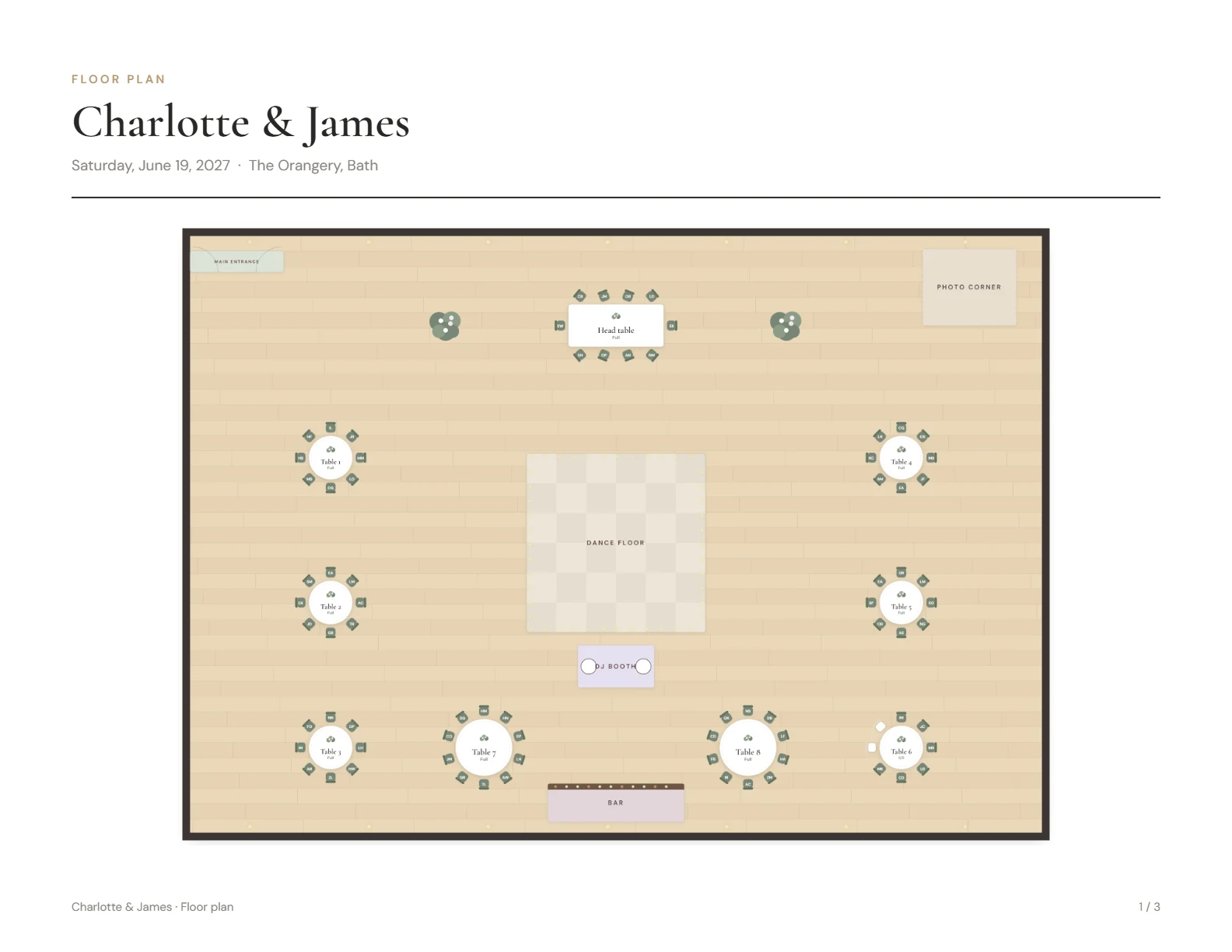
Mixing round and rectangular tables
You don't have to choose just one. Many receptions combine them:
- a long head table or family table, with rounds for everyone else;
- rounds near the dance floor and long rows along the walls, to fit more guests in an awkward room;
- a long kids' table that is easy for parents to keep an eye on.
Mixing shapes also helps when your groups come in odd sizes: a group of 13 can share a long table instead of being split across two rounds.
Try your layout before the venue visit
Set your room's size, add round, rectangular and imperial tables at their real sizes, and see how many guests fit. Free to start, no sign-up.
Start freeSee how it works